


Tranche 2 is now in effect
As of 1st July 2026, Australia’s anti-money laundering laws have expanded. If you work in real estate, conveyancing, accounting, legal or virtual asset services, you may be subject to new AML/CTF compliance obligations known as Tranche 2.
What is Tranche 2 and AML/CTF?
Tranche 2 refers to the expansion of Australia’s Anti-Money Laundering and Counter-Terrorism Financing (AML/CTF) Act to include additional professions and industries. It brings more professions under AUSTRAC regulation to detect and prevent financial crime.
It requires businesses and professionals to verify customer identities, monitor transactions and report suspicious activity to AUSTRAC.
Who needs to comply with Tranche 2?
- Real estate agents (including buyer’s agents and property developers)
- Conveyancers
- Accountants and tax agents
- Lawyers
- Virtual asset-related services
- Other service providers offering designated services
If you handle client funds, large transactions or high-risk financial activity, these rules will likely apply to you. If you're unsure if these rules apply to you, use AUSTRAC’s online check to confirm and act quickly if they do.
When did Tranche 2 come into effect?
Tranche 2 obligations commenced on 1 July 2026. AUSTRAC enrolment for newly regulated businesses closed on 29 July 2026.
If you haven't enrolled or started your AML/CTF program, you're already behind, and AUSTRAC can act on non-compliance now, not eventually.
JUN
1
Public consultation on draft rules
JUL
AUG
2
Final AML/CTF Rules Published
SEP
3
Learn About the Changes in Detail
OCT
NOV
DEC
4
Sector-Specific Guidance Finalised
JAN
5
Choose AML Provider or Develop Internal Processes
FEB
MAR
6
Formal Austrac
Enrolment Opens
APR
Finish System Setup
Trial Run
MAY
JUN
7
Relax if You're with easyAML
JUL
8
Obligations Commence
What is required under Tranche 2?
-
Enrol with AUSTRAC immediately
AUSTRAC enrolment closed on 29 July 2026. If you haven't enrolled yet, do it immediately to limit your exposure.
- Complete AUSTRAC enrolment form
- Provide business structure details
- List designated services offered
- Identify key personnel
- Submit contact information
- Appoint a compliance officer
- Establish reporting channels
- Set up AUSTRAC Online access
How does easyAML help?
- Step by step guidance
- Local support whenever you need it
-
Implement an AML/CTF Program
Your business is now required to have a written, risk-based AML/CTF program in place. If you don't, put one together now.
- Develop written AML/CTF policies
- Create CDD procedures
- Design transaction monitoring
- Build reporting processes
- Establish record-keeping systems
- Create governance structure
- Document all procedures
- Formally approve Program
How does easyAML help?
- Industry-specific AML/CTF program builder
- Guided, AUSTRAC-aligned risk assessment setup
- Complete program - policies, procedures, and controls
- Your program is kept up to date and compliant
-
Verify your customers
Conduct checks to verify the identity of buyers and sellers that you deal with on property transactions.
- Conduct ML/TF/PF risk assessment
- Identify customer risk factors
- Assess product/service risks
- Consider geographic risks
- Document risk methodology
- Evaluate delivery channel risks
How does easyAML help?
- Easy biometric identity verification (Powered by Scantek)
- PEPs, sanctions & criminal watchlists screening
- ABN/ACN lookup and beneficial owner checks
- Complete KYC, KYB and KYE checks
-
Ongoing due diligence
Regularly monitor client activity and reassess their risk. Records need to be maintained for at least seven years.
- Undertake Customer Due Diligence
- Monitor customer transactions
- Review customer risk ratings
- Track regulatory changes
- Conduct internal audits
- Test compliance controls
- Measure program effectiveness
- Report to management
How does easyAML help?
- Continuous transaction monitoring
- Customer behaviour analysis
- Automated risk assessments
-
Reporting suspicious matters
Report activity that seems unusual or suspicious to AUSTRAC.
- Submit SMRs within 72 hours
- File TTRs for $10,000+ cash
- Report IFTIs
- Maintain 7-year records
- Respond to AUSTRAC requests
- Annual compliance reports
- Board/management updates
- Document all decisions
How does easyAML help?
- Suspicious activity alerts
- One click AUSTRAC-ready reports
- Secure 7 year record storage compliance
-
Staff Training
Make sure your team understands red flags and reporting steps.
- Develop role-specific training modules
- Conduct initial training for all staff
- Implement new employee onboarding
- Schedule annual refresher training
- Create sector-specific risk training
- Test understanding with assessments
- Establish clear reporting lines
- Define roles and responsibilities
How does easyAML help?
- On-demand compliance training modules
- Quizzes, walkthroughs and downloadable resources
- Local Australian-based support whenever you need it
What are the consequences of non-compliance?
-
Legal consequences
Now that Tranche 2 is in force, AUSTRAC can take action against non-compliant businesses immediately. Depending on the nature and severity of the breach, this may include:
- Enforceable undertakings. These are court-enforceable commitments to fix compliance failures.
- Infringement notices. Fines for specific breaches of AML/CTF rules.
- Remedial directions. Instructions to take specific action to prevent the same breach from occurring again.
- Civil penalty orders. Financial penalties imposed by the courts for serious breaches.
- Written notices. AUSTRAC may direct you to appoint an external auditor or conduct a risk assessment.
- Suspension or cancellation of registration.
- Referral for criminal investigation, where appropriate.
-
Penalties
Failing to comply with AML/CTF laws can result in significant fines. AUSTRAC penalties are calculated using penalty units. Currently, one penalty unit is valued at $313.
- Individuals who breach their AML/CTF obligations can be charged up to 20,000 penalty units. This means an individual can be charged up to $6,260,000.
- Body Corporates that breach their AML/CTF obligations can be charged up to 100,000 penalty units. This means a body corporate can be charged up to $31,300,000.
It’s important to realise that these aren’t just "big bank" numbers.
These penalties can be applied by AUSTRAC to any business that fails in its anti-money laundering obligations.
How much will Tranche 2 compliance cost?
If you haven't started your AML/CTF program yet, here's what it costs to get compliant now… and how much faster and cheaper that is with easyAML.
Without easyAML:
According to the RIS by the Attorney General’s Department, the average ongoing cost per business is $23,250 per year. Costs will vary from business to business and may include:
- Administration time and lost productivity.
- Software fees, including KYC/KYB tools.
- Professional consultation and services fees.
- Staff training and appointment of AML/CTF compliance officer.
- Policy and AML/CTF program drafting by legal experts.
With easyAML:
- All-in-one platform for complete Tranche 2 compliance.
- Step-by-step guidance with no compliance experience required.
- Local Australian support team for all of your Tranche 2 queries.
- Program implementation in as little as 30-40 minutes.
- Seamless workflows built specifically for Tranche, to minimise administration burden and maximise ease of compliance.
Pricing starts at $179/month +gst for a team of 5.
Tranche 2 compliance is easy with easyAML
Our AML/CTF platform is purpose-built for Australian businesses facing Tranche 2, supported by our local Aussie team.
- Step by step guidance
- Fully AUSTRAC-aligned solution
- No compliance experience required
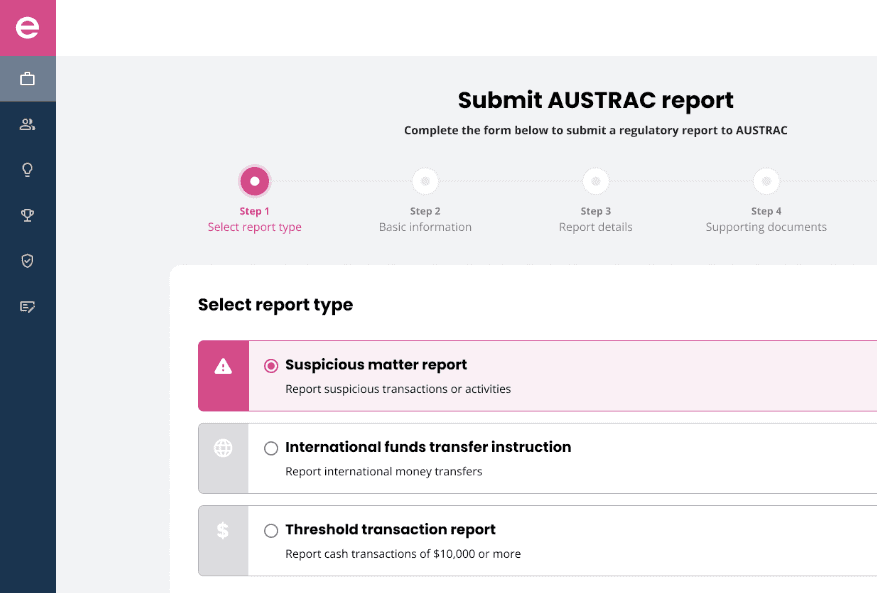
Join a webinar and get the answers you need
Register for one of our upcoming sessions to see how easyAML turns complex Tranche 2 requirements into simple steps, with real examples and a chance to ask your questions.

Tranche 2 AML/CTF FAQs
-
What do I need to do since Tranche 2 is already in effect?
If your business hasn't enrolled or doesn't have an AML/CTF program in place, you're operating out of compliance today. The priority now is getting compliant as quickly as possible since Tranche 2 obligations went into effect as of 1 July 2026 and AUSTRAC enrolment closed on 29 July 2026.
-
I haven't started yet. Is it too late?
No, but there's no more runway. Enrolment closed 29 July 2026, and obligations are already enforceable. Every day without a program in place is a day of exposure to AUSTRAC action. The fastest path is getting your enrolment and program sorted now, with support so you don't get it wrong under time pressure.
-
What happens if I don’t comply with Tranche 2?
Tranche 2 obligations are now live. If your business hasn't complied, you could face regulatory action from AUSTRAC today, not at some point in the future. Failing to comply could risk fines, investigations or even client trust.
-
How much will AML/CTF compliance cost?
We know cost matters, especially for small businesses. That’s why easyAML is built to be affordable and scalable. Here’s how Tranche 2 costs might look based on the Attorney General’s Department’s Impact Analysis estimates:
Business Turnover Upfront Cost Annual Cost Under $200,000 ~$4,040 ~$6,020 Over $200,000 ~$28,650 ~$33,230 -
Where can I learn more about Tranche 2 AML/CTF?
Head to AUSTRAC’s official website for updates, or contact the easyAML team to discuss your specific situation and next steps. We're here to help you navigate what's coming with clarity and confidence. Our support team handles the ongoing monitoring and updates, keeping compliance simple for your business.
-
What’s the difference between Tranche 1 and Tranche 2?
Tranche 1 covered banks, casinos and money transfer services. Tranche 2 extends AML/CTF obligations to real estate agents, lawyers, accountants and other professional services. While Tranche 1 businesses have been complying for years, Tranche 2 has now brought these requirements to small and medium businesses for the first time.
-
Can my small business be exempt from Tranche 2?
Most businesses in covered sectors will need to comply, regardless of size. While final exemptions aren't confirmed, AUSTRAC typically doesn't provide blanket small business exemptions for AML/CTF obligations. It's best to assume you'll need to comply and get in touch with our team to discuss further.
-
How will AUSTRAC check if I'm compliant?
AUSTRAC checks compliance through things like document reviews, site visits and monitoring your reporting. If your policies, procedures, training records and systems are solid and your records are up to date, you’ll be in good shape. Proper documentation is essential in demonstrating your compliance efforts during any AUSTRAC review or audit.
-
I missed the 29 July enrolment deadline. What now?
If you haven't enrolled with AUSTRAC yet, don't wait any longer. Enrol as soon as possible and put your AML/CTF program in place.
AUSTRAC's enforcement approach typically escalates from guidance to formal action, so acting now, even after the deadline, puts you in a stronger position than putting it off any longer.
-
Do I actually need written AML policies, or is a checklist enough for Tranche 2?
You need documented, written policies. A checklist tells you what to do, but doesn't show AUSTRAC why decisions were made a certain way. If your business is ever reviewed, your policies are what demonstrate your thinking, not just your actions.
-
Can we just use a free or templated AML policy?
You can, but it's risky under Tranche 2. Generic templates describe risks and processes that may not match your business. If your policy says you apply Enhanced Due Diligence in certain cases and your team doesn't consistently do that, you've created a bigger problem than having no policy at all. There’s a gap between what you say and what you do.